
Digitize or Die – Adopting Digitization in The Workplace
Advice

Digitize or Die – Adopting Digitization in The Workplace

Nick Charalambous
Nick Charalambous30th Jun 2020 • 4 min read

”Survival of the fittest is not the strongest but the one that can adapt best” – Darwin
Now more than ever, adopting digitization in the workplace is essential for survival. Considering that the COVID-19 situation is evolving expeditiously it is increasingly unlikely that business practices will ever return to normal once the virus is contained. Social distancing has become the new norm and industries are set to change forever as new priorities have led to shifting demands from consumers.

In particular, the financial services industry where we were heavily reliant on face-to-face meetings.  The mantra ‘’innovate or die’’ has never been more pertinent and we had to adapt quickly and adopt a digital culture to remain competitive.

Innovating in the financial industry

Innovation is an essential element of Ireland’s overall economic development policy and is central to maintaining competitiveness in both global and domestic markets.  A study from Microsoft revealed that 80% of Irish SMEs are not as digitally shrewd as they seem to think and 48% are concerned about not keeping up with technological advancements. We believe it is crucial that SMEs overcome transformation anxiety and prioritise investing in digitalisation.

Similarly to most companies, we adopted the use of video calls for online consultations with clients. We had to familiarize ourselves with new software called DocuSign to manage electronic agreements which offers eSignature, a way to sign electronically on different devices. In the beginning, this was all very difficult but we can’t emphasise enough how overcoming transformation anxiety has helped us throughout this difficult period. We have made use of Webinars and offered free financial advice clinics to specific industries which have helped us build relationships, connect more deeply with our audience, and most importantly help those who are in need of financial advice.

Webinars

Webinars are extremely cost-effective compared to other marketing tools and hosting a webinar is a great way to generate content for your company’s online presence. Webinars are more about teaching than presentations. The biggest benefit of webinars belongs to the audience. That’s because the way content is explained in a webinar is really much, much more intimate than it could ever conceivably be in other kinds of presentations.

The pandemic has led to us exploring new avenues and webinars have certainly been a positive aspect of that. However, we are almost coming to the end of the webinar series with only two remaining. If you would like to attend our next webinar on Wednesday, July 8th you can register here. The series comes to an end on the 15th of July where we will be discussing how you can save 40% off your Tax. For more information please do not hesitate to contact us at (021) 206 1780 or contact@alphawealth.ie

Wednesday, July 8th – https://alphawealth.aidaform.com/financial-advice-webinar

Wednesday, July 15th – https://alphawealth.aidaform.com/tax-back-investment-options-registration-form

Nick Charalambous

Nick Charalambous

30th Jun 2020

Share this post

LinkedInTwitterFacebook

Related articles

Tracker Mortgage Scandal Q&A
Advice

Tracker Mortgage Scandal Q&A

Unless you have been hiding behind a rock for the past couple weeks, you would have noticed the coverage of the tracker mortgage scandal in the media. This is where banks have been accused of wrong doing to the public in relation to tracker mortgages taking out. I will run through a few questions that should help shed light on the area. The banks calculated that, even though they might lose money on these products, they could then “hook-in” the people who owned trackers and up-sell them more loans for cars, home improvements, and holidays, all of which would carry higher rates. The higher rates for other loans would off-set the losses on trackers and the banks got sneaky and reacted in the way they always do which is to screw the customer for the banker’s own mistakes and miscalculations.

Could you have been caught up in the tracker mortgage scandal?

Possibly. If you were ever on a tracker and were taken off it. No matter what the reason for this change, you could be one of 13,000 accounts to date affected, although that is by no means certain.

How would I know?

It is known that the banks are committed to going through their loan books to find all those who were affected. They were ordered by the Central Bank to make contact with those customers affected. Unfortunately, not everyone who was incorrectly denied a tracker has been contacted, and the banks and the Central Bank are still disagreeing over some accounts that the regulator considers were affected notwithstanding claims to the contrary by some banks.  And guess what there are many thousands more have been affected. Add a healthy figure onto the13, 000 or so that are currently in the system.et

So do I just have to wait until the Central Bank process is over?

Right now the Central Bank is “the only game in town”, keeping updated by reading the various media outlets will help assure you of what is happening.
Facts to date

  • €163m paid to customers in refunds and compensation a ‘fraction’ of money owed
  • Customers will ultimately foot bill for tracker scandal
  • Full extent of tracker scandal remains unclear

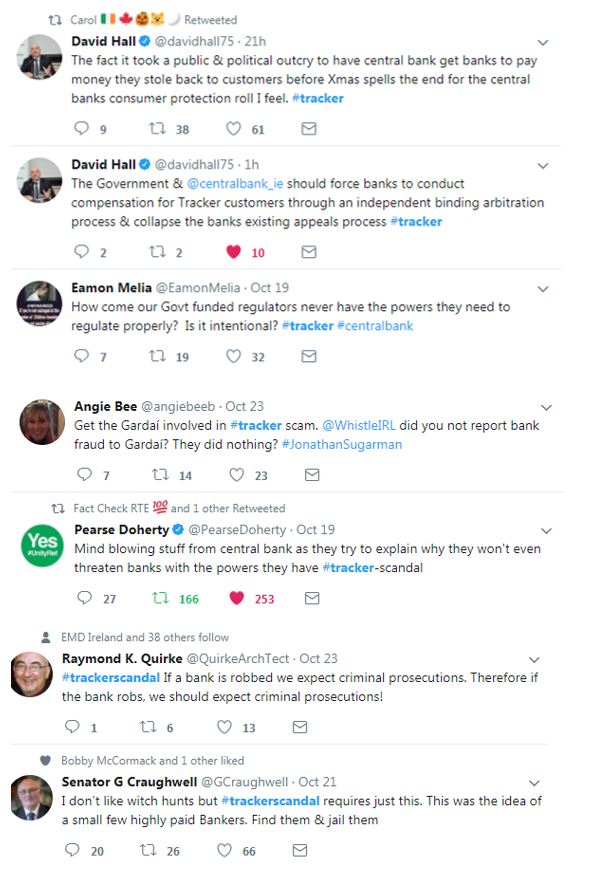
What has twitter got to say?

The big question ever has is should I take a legal action against my bank myself?

You could and by all means, you should do this. The legal avenue is open to anyone who considers they have been wronged. Unfortunately, this process is slow and very expensive. And many of those worst affected simply do not have the financial resources to take a High Court action, which is why the best advice is still to wait for the process to end.
 

When will it end?

It is progressing very slowly. This all started in 2015. Some banks have been proactive in dealing with cases; AIB and PTSB have dealt with a significant number of cases already. Ulster Bank have started to move. Bank of Ireland and KBC, on the other hand, have been very slow off the mark.

You will have some entitlements if you have been adversely affected by the bank’s misconduct.

  1. You will have to have the tracker restored.
  2. All the interest you overpaid will have to be repaid to you – or used pay off the mortgage.
  3. You will be entitled to compensation. (This will be decided by the bank initially and the Central Bank will review to see if this figure is suitable, the Central Bank is demanding the banks do more).

How do you fix it?

It seems that the whole issue is wrapped up by an industry who views success in the short-term, quarterly-results with which our global financial system has become obsessed.

The problem is the core culture that exists within these financial institutions. One has to ask themselves is it too much to demand a certain morality in the boardroom? Is it too much to ask for a few good men and women who apply morality to their business life? If not, we are in a troubling Ireland.

READ MORE 24th Oct 2017
What Your Relationship with Money Says About You
Advice

What Your Relationship with Money Says About You

If you want to truly know yourself, pay close attention to the way you treat money.

John Armstrong renowned British writer once said: “One’s relationship with money is life long, it colours one’s sense of identity, it shapes one’s attitude towards other people, it connects and splits generations; money is the arena in which greed and generosity are played out, in which wisdom is exercised and fully committed. Freedom, desire, power, status, work, and possession: these huge ideas that rule life are enacted, almost always in and around money.”

You will find that your relationship with money puts you in one of the following categories:

Obsessive:

You believe that attracting and accumulating money is the sole purpose of your life. Health, energy, time, peace, relationships, ethics — there’s nothing you will not sacrifice in your pursuit of money. Your unhealthy relationship with money has made you obsessive to the point of being dangerous to not only yourself but everyone around you. So you decide to try fight a guy in a different sport who has a record of 49/49 at top level of boxing. Introducing in the red corner Cooonnnor Mcgreeeegor.

Reckless:

Addicted to the highs that money can give you. This makes you spend money even if you haven’t earned it yet. As a result, you find that you are perpetually in debt. You may have even become a financial burden to someone else. People often hear you say that you never have enough money. You are usually anxious and discouraged because of your inability to repay your debt. This is like the gambler who tells you only about his wins but never about his losses.

Daydreamer: 

You dream of being wealthier, but you rarely take action to make those dreams come true. Believing that because you are a good person, money will come.  Your idealistic attitude towards money also causes you to lend money to others even when you don’t have enough to sustain yourself. As a result, you experience more lows than highs.  Somewhat similar to Father Dougal McGuire’s perception of dreams vs reality.

Freeloader:

You don’t bother to earn or save money, even though you are capable of doing so. You are habituated to living off people’s generosity. This has caused you to become a burden to everyone around you — especially your family and close friends. Waiting for others to meet your monetary needs has also caused you to become frustrated and angry, and even harbour feelings of rejection.

Dependent:

You rely on others for money because you are currently in a situation that prevents you from earning. This has caused you to lose your self-confidence and even feel guilty and inferior to others. You fail to realise that you can become financially independent by investing the passive income you receive from others.

Wise:

You value money, but don’t worship it. You know that money is a means to an end and that you need it to help yourself and others. So, you have developed ways to generate it without affecting your well-being. It is clear that obsessiveness or recklessness doesn’t hinder your decisions you make with your money. Instead, you have disciplined yourself to not spend impulsively or let greed overtake you. You know that growing your wealth is better than hoarding it. People often look to you for financial advice. (**cough Alpha Wealth)

If your relationship with money currently shows you are anything but wise, don’t fret. It’s never too late to start treating money well. The main step is to change your perspective about money. The best way to do that is by understanding the role that emotions play in all your money matters. We here at Alpha look at more than just your money! You matter.

READ MORE 15th Jun 2017
8 ways we can help improve your lifestyle
Advice

8 ways we can help improve your lifestyle

Why us?

We thought it might be useful to step back a little bit and review the value that we bring to our clients, in order to make sure we’re meeting your needs as much as we possibly can. We identified ways in which we enrich the lives of our clients and ended up with quite a long list! We then came up with the idea of narrowing down this list and sharing with you 8 ways in which we can help you to improve your lifestyle.

CUPCAKE

Tax relief is applicable when you effect an income protection policy (policy taken out in case of an accident, illness etc). The tax relief is available at your marginal rate of tax of 20%/40%.

  1. We help you develop a financial plan to achieve your desired lifestyle

When you set out on a journey, you need a map to get to your destination. The same applies to your desired lifestyle and the finances to achieve it. Think of your desired lifestyle as the destination. The map you need is a financial plan. This will show you what is needed to live the life that you want to live.

  1. We help you sleep at night

We’re firm believers in the principle of risk based investing. Your portfolio needs to clearly reflect your own appetite for risk in order to ensure that your money is working as hard as possible for you, while not increasing the risk in your portfolio beyond your comfort levels. We don’t want you lying awake at night worrying about your portfolio.

  1. We make sure an unexpected event doesn’t dash every hope and dream

Life is full of uncertainties that impact all of us every single day. Sometimes significant events change the course of your life and the lives of your loved ones. A serious illness or the death of a parent has an enormous emotional impact on a family. It can also be catastrophic financially and dash a lot of dreams. It’s our job to help you protect yourself financially against such events.

  1. We help you reduce your tax

We’re very aware of how taxation can take large chunks out of your financial assets. We stay on top of changes to the taxation regime and this knowledge helps us to ensure you are reducing your tax bill as much as possible. This applies of course to retirement planning, but we also look to find tax saving opportunities in your investments, life assurance and income protection planning. We want the money in your pocket rather than the taxman’s!

  1. We help you to keep your discipline and focus on long terms goals

Our goal is to help you live the life you want to live, both today and tomorrow. We’re not killjoys, only trying to get you to save as much as possible for the future! Instead we help you strike a balance between spending today and saving for the future. We want you to achieve your long-term financial objectives while living your life to the full.

  1. We make sure your plan remains relevant

People get married, babies come along and people change jobs or even careers, future aspirations change. All of these types of events fundamentally change your financial plan. It’s our job to make sure that all of these changes are fully reflected in your plan and that you have the optimal set of financial solutions in line with your changing circumstances.

  1. We help you to understand the swings and roundabouts of investment markets

Investment markets are moving up and down all of the time. Some people don’t notice, others sweat over every (downwards) movement. Often this is down to a lack of understanding of markets, volatility and how it works, and the impacts on your own portfolio. While ensuring you have the optimal risk based portfolio in place is an important job for us, it’s equally important that we help you understand how markets work.

  1. We help you to make your debt v investment decisions

When incomes increase and there’s some extra cash left over each month, or indeed you get a windfall as a result of a bonus, a gift or maybe an inheritance, you’ve got decisions to make. Do you pay down debt or invest? We can help you make those decisions, taking account of interest rates, projected risk-based investment returns and tax considerations. We want your money working as hard as possible for you.

Result = Happy YOU.

READ MORE 18th Apr 2017