3 Reasons You Should Break Up With Your Financial Advisor
Financial Advisors

3 Reasons You Should Break Up With Your Financial Advisor

Nick Charalambous
Nick Charalambous10th Nov 2022 • 3 min read

Not every relationship is a “fit,” and sometimes people have to break up. This happens in all walks of life, sometimes business partnerships and personal relationships have an expiration date, and the same might also apply to your financial advisor. In this blog post, we will be highlighting three key reasons that you should consider moving financial advisors.

  1. Lack of communication
  2. Your circumstances change but your advice doesn’t
  3. Fees are not explained

Lack of Communication

Like any relationship, communication is key. A high level of customer service includes regular communication. If your advisor isn’t getting back to you or providing updates you are being taken for granted. Sometimes advisors are busy and responses may not be instant but you should not be getting ignored. A responsive advisor is a good advisor.

Lack of communication from a financial advisor

Your Circumstances Have Changed, but the Advice Stayed the Same

Your financial advisor should tailor the advice to your personal financial situation. Financial conditions can change dramatically over several years, and the last few years have had some big ups and downs. If you’ve received the same guidance year after year despite economic changes, especially if you’re getting close to retirement, there is a disconnect with your advisor, and your needs are not being met.

Your Circumstances Have Changed, but the Financial Advice Stayed the Same

Fees Are Not Explained to You

First of all make sure your advisor is not tied to any agency. You want an advisor who has your best interest at heart and if they are tied to an agency they can only offer you that agency’s financial products. Ask your advisor to explain their fee structure to you and make sure you are not paying excessive fees. A great advisor will explain how their fees work and be completely transparent with you.

Unexplained financial advise - image of handing over money

If your current financial advisor does any of the above we strongly recommend that you break up. It’s time to find a new partner and we think that we would be a great match. Book an appointment with us today and let us help you towards achieving financial freedom.

We are running a free webinar on November 17th where we will be explaining the best financial tips to help you kickstart 2023.

Nick Charalambous

Nick Charalambous

10th Nov 2022

Share this post

LinkedInTwitterFacebook

Related articles

Benefits of using a financial advisor: 
Financial Advisors

Benefits of using a financial advisor: 

The success of your financial life can often determine the quality of your actual life. Working with a financial advisor can help you establish a successful financial plan to achieve the goals you’ve set for yourself and your family.  

Because choosing a financial advisor can be tough, we’ve outlined some of the key benefits of working with effective financial planning services. With many things to think about, there are different types of financial advisors who can help you along your journey.  

Here are the key benefits of using a financial advisor: 

1. To protect your family

There are a myriad of life insurance products on the market; a financial advisor can tell you which ones are actually worth buying.

They will assess your position and guide you through the best options to protect yourself and your family – whether you are single or married, have a young family, or are approaching retirement.

Financial advisors help protect your family

2. To help plan your spending and saving

To secure your long term future, you need to build some assets – initially to get you through the rainy days and then to pay for holidays and luxuries.

Step one is to plan your spending so that you begin to save, and step two is to plan that saving so that you can build your wealth as efficiently as possible. Irrespective of amount, a financial advisor can look at your situation and find the best starting point for you.

3. To help you plan for retirement

Once your short term saving needs are covered, you can start thinking about the long term. Most people these days realise that they cannot rely on the state for more than the absolute basics.

Planning for retirement is a complex business, and there are many different options available. A financial advisor will not only help sift through the many rules and product options and help construct a portfolio to maximise your long term prospects.

Couple enjoying retirement at the beach

4. To secure your house

The mortgage market is complicated, even more so in the aftermath of the increase in interest rates, with mortgages now even more complex and lenders’ requirements more stringent.

Buying a house is one of the most expensive decisions we make and the vast majority of us need a mortgage. A financial advisor could save you thousands, particularly at times like this. Not only can they seek out the best rates, they can help you assess sensible levels of borrowing, make the most of your deposit, and might also find lenders who would otherwise not be available to you.

5. To help you meet your investment goals

As you progress through life and your assets and income begin to increase, you can start considering how to enhance your position rather than simply consolidate it. This could mean anything from looking to retire early or paying college fees for your children. Whatever your goal, a financial advisor can help assess what is realistically possible and plan with you to help you achieve it.

6. To find the right combination of assets

Investment is as much about protecting against potential downsides as it is about targeting maximum growth. High returns are often associated with high risk and not everyone likes the idea that their investment might fall by a third or more overnight!

A financial advisor will make a detailed assessment of your attitude to risk before making recommendations. They will also ensure you don’t put all your eggs in one basket by helping you diversify not only across asset classes but also across accounts, individual funds and product providers.

Financial advisor helping client plan

7. To obtain an objective assessment

Every new investment opportunity or product is likely to be accompanied by a certain amount of hype but that doesn’t necessarily mean it is right for you. Investors will continue to be caught out by market ‘bubbles’ or high charges because they rush headfirst.

A financial advisor knows how products work in different markets and will identify possible downsides for you as well as the potential benefits, so that you can then make an informed decision about where to invest.

8. To save money

Once your risk and investment assessments are complete, the next step is to look at tax; even the most basic overview of your position could help.  You could join the Alpha Savings & Investment Club to give your hard earned savings the opportunity to earn interest.

For more complicated arrangements, it could mean moving assets to your spouse or children to maximise their personal allowances instead. A financial advisor will always have your tax position in mind when making recommendations and point you in the right direction even in complicated situations.

9. To keep you on track

Even when your investments have been put in place and are running to plan, they should be monitored in case market developments or abnormal events push them off course.

You can ask a financial advisor to keep a watchful eye on your investments. They can assess their performance against their peers, ensure that your asset allocation does not become distorted as markets fluctuate and help you consolidate gains as the deadlines for your ultimate goals move closer.

Happy family after using a financial advisor

10. For peace of mind

Money is a complicated subject and there is lots to consider to protect it and make the most of it. Markets are volatile and the media are prone to exaggerate the risks and rewards. Employing a good financial advisor can cut through the hype to steer you in the right direction.

Whether you need general, practical advice or a specialist with dedicated expertise, you could find that in the long term the money you invest in expert advice will be paid back many times over.

If you have any questions on please feel free to contact us or check out this Savings Calculator to see how much you could potentially earn. Alpha Wealth are delighted to be recognized as one of the top financial advisors by Best In Ireland.

READ MORE 8th Aug 2022
Inflation – What is it?
Financial Advisors

Inflation – What is it?

What is inflation?

Essentially inflation is the decline in value of a Currency ie € and the increase in price of good and services. A basic example of this is today you can buy 1 apple for €1 tomorrow it will cost you €2 to buy 1 apple. You now need to spend more euros to get the same product or service.  

RISE IN THE COST OF LIVING 

So why has the price of apples above increased? 

Price increases generally come from the manufacturer passing the increased cost of raw materials, wages, fuel etc over the customer.  

A second point worth noting, a surge in demand for goods and services will increase the price of the goods. A good example of this right now is the price of houses in Ireland.  Increasing demand and a shortage in supply results in higher prices as consumers are willing to pay more.  

How does it impact you negatively? 

As mentioned above inflation reduces the value of your money. So if you have €100 at home under the mattress or in a deposit account, today you can buy 100 apples. The following day as inflation increases the €100 you own now has devalued by half. You can only buy 50 apples with the same money.  

Holding money at home or in a low interest deposit account is bad for the consumer and your money.  

Are there any benefits to inflation? 

In one word absolutely. To some they see the sign of inflation as a struggling economy, while others see it as a time of potential prospering economy.  

As inflation erodes the value of cash, this is seen as an opportunity by some consumers to spend or invest money where it can hold or grow in value.  

When goods and services are in demand it has the potential to lower the rate of unemployment in an economy. As more people are working and have increasing disposable incomes they are more likely to spend. 

Lastly, inflation reduces the cost of borrowing. Referring back to the example above where if you borrowed €100 to buy 100 apples. With inflation as pay back the lender the next day the value of the €100 is worth less (50 apples) compared to when it was originally borrowed. 

Effect of inflation on prices

How can you combat inflation? 

Individually we cannot stop or avoid inflation. Although the ECB does try to control and target an inflation rate of around 2%. Through monetary policy the ECB can increase or decrease inflation by increasing or decreasing the supply of money in economy.  

How individuals can reduce the impact of inflation on their cash.  

1.     Invest in yourself & upskill. 

As inflation can have a negative impact on peoples cost of living, upskilling is a great tool to potentially increase your income. Increasing your skills and knowledge may allow you to generate additional income from your full time employment and provide a greater disable income for you and or your family.  

2.     Investing in the stock market  

Statistics show that the stock market has consistently provided positive returns in the long run. While short term dips are unwelcome the market has always bounced back over time and shown growth.  You should check out our recommended Zurich funds in the Alpha Savings & Investment Club

3.     Diversify your portfolio 

Diversifying your portfolio in an actively managed fund protecting against inflation but also any down turns in the market. Commodities and commodity resource companies tend to do well during these times as well as some cases for healthcare companies and property. Equities Generally do not perform well during times of inflation as interest rates rise.  

READ MORE 14th Jul 2021
Christmas Bonus 2017 – Welfare and Pensions
Financial Advisors

Christmas Bonus 2017 – Welfare and Pensions

As announced in Budget 2018 – A 2017 Christmas Bonus will be paid out again this year to eligible welfare and state pension recipients. The 2017 bonus of 85% will be paid to the majority of people along with their normal weekly payments during the week beginning November 27th, 2017. Those people doing part-time work and getting Jobseekers Allowance will usually get any Christmas Bonus in the following week (commencing 4th Dec.)

Anyone getting monthly payments will get any Christmas bonus due in their normal December payment. If you are getting 2 eligible social welfare payments you will get the Christmas Bonus in respect of both payments.

There will also be the usual “double week” of welfare and pension payments just before Christmas.
About 1.3 million people will benefit from the Christmas Bonus  (almost 900,000 recipients and an estimated 400,000 dependents). Around €219 million Euro will be paid out.

See the list at the end of the article for all the state pensions/benefits that are eligible for the Christmas Bonus 2017

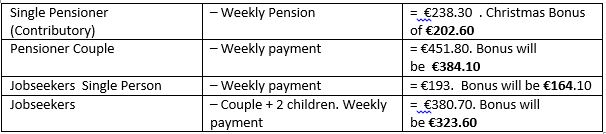
Some Sample Figures for the Christmas Bonus 2017

The following payment types are eligible for the Christmas Bonus in Ireland…

  • Back to Education Allowance (people coming from Jobseeker’s payments must have been on their payment and/or BTEA for 15 months)
  • Back to Work Family Dividend
  • Back to Work Enterprise Allowance
  • Blind Pension
  • Carer’s Allowance and Benefit
  • Community Employment
  • Deserted Wife’s Allowance and Benefit
  • Disability Allowance
  • Disablement Pension
  • Domiciliary Care Allowance (85% of the weekly amount )
  • Farm Assist
  • Gateway
  • Guardian’s Payment (Contributory) and (Non-Contributory)
  • Invalidity Pension
  • Job Initiative
  • JobBridge (people coming from jobseeker’s payments must have been on their payment and/or JobBridge for 15 months)
  • Jobseeker’s Allowance (long-term only – over 390 days or 15 months unemployed on JB/JA)
  • Jobseeker’s Allowance (Transition)
  • Magdalen Laundry Payments
  • One-Parent Family Payment
  • Partial Capacity Benefit
  • Pre-Retirement Allowance
  • Rural Social Scheme
  • State Pension (Contributory), (Non-Contributory) and (Transition)
  • Supplementary Welfare Allowance (only – over 391 days or 15 months)
  • Widow, Widower’s or Surviving Civil Partner’s Pension (Contributory) and (Non-Contributory)
  • VTOS (people coming from jobseeker’s payments must have been on their payment and/or VTOS for 15 months)
  • People getting Blind Welfare Allowance, Mobility Allowance, and rehabilitative training allowances from the HSE  will also get the bonus.
  • Survivors of Thalidomide who get payments from the Department of Health will also get the Christmas Bonus in 2017.
  • The Christmas Bonus is also being paid to certain participants of Community Employment, Back to Education, Rural Social Scheme, Gateway, Tus and the Back to Work Family Dividend
  • It is also paid to most participants on Further Education and Training courses funded by SOLAS.  (you must have been getting your jobseeker’s payment and/or your training allowance for 15 months)

For any other questions or queries please talk to one of our financial advisors.

READ MORE 12th Dec 2017